What does hail damage look like on a Carpentersville asphalt roof?
Fresh hail often knocks granules off in dark, random spots and can bruise the mat underneath. Stay off the roof and off a ladder; read the slope from the ground. Cracked tabs, dented soft metal on vents and gutters, and a sudden wash of granules in the downspouts are the clues you can check safely. Age-related wear looks more uniform and is heaviest on the sunniest slopes.
Hail in northern Illinois is usually a spring and early summer event, riding thunderstorms that cross Kane County and the Fox River valley. Stone size and which slopes faced the storm both matter. A burst of pea-to-marble hail can knock the protective granules off an asphalt shingle and leave a bruise in the mat. Larger stones crack tabs, split ridge caps, and dent the soft metal around the roof.
From the yard, fresh hail marks often look like dark, random spots rather than the even fading of a south-facing slope that has baked for years. Granules pile up in gutters and at the bottom of downspouts in a way that was not there the week before. The pattern is scattered across slopes that faced the storm, including slopes you do not see from the street.
Bruising is easy to underestimate because the ceiling stays dry. The shingle can be fractured and still shed the next light rain. The failure shows up later, when the damaged mat cracks further in heat and cold, or when wind lifts a tab that no longer seals. That is why a storm estimate looks for impact marks, not only for daylight and drips.
Hail damage and ordinary wear are different stories, and they should stay separate on an estimate. Uniform granule loss on a 20-year south slope is aging. Random bruises that appeared the afternoon a cell passed over Carpentersville, matched by dents in gutters and vent caps, are storm marks. Mixing the two leads to a scope that does not match the roof.
Wind along the river and across open lots
Straight-line wind does a different kind of damage from hail. It lifts the leading edge of a shingle, creases the mat, and tears tabs off in rows. Ridge caps and hip caps go first on many houses because they sit highest and catch the gust. A slope that faces west or southwest — the usual direction of both prevailing wind and many storm outflows in this part of Illinois — loses shingles before a sheltered east slope does.
Homes on higher ground along the Fox River, and houses on lots open toward the valley or Route 31, see that exposure more than a roof surrounded by mature trees and close neighbors. After a serious wind event, including regional straight-line storms such as the August 10, 2020 derecho that crossed northern Illinois (NOAA logged an estimated 65-knot gust just west-southwest of Carpentersville that afternoon), whole courses can be gone and the underlayment or deck can be open to the sky. Smaller events only crease a handful of tabs and leave them lying flat again, where they leak on the next wind-driven rain without looking dramatic from the curb.
If tabs are in the yard, photograph them where they landed and note which side of the house they came from. If the deck is bare, say so when you request a free storm damage estimate. Exposed wood should be covered before the next rain. Do not climb a wet roof to spread a tarp. If water is already indoors, catch it, move what you can, and include that in the request so the visit starts with the open slope.
Hail and wind damage on the same roof
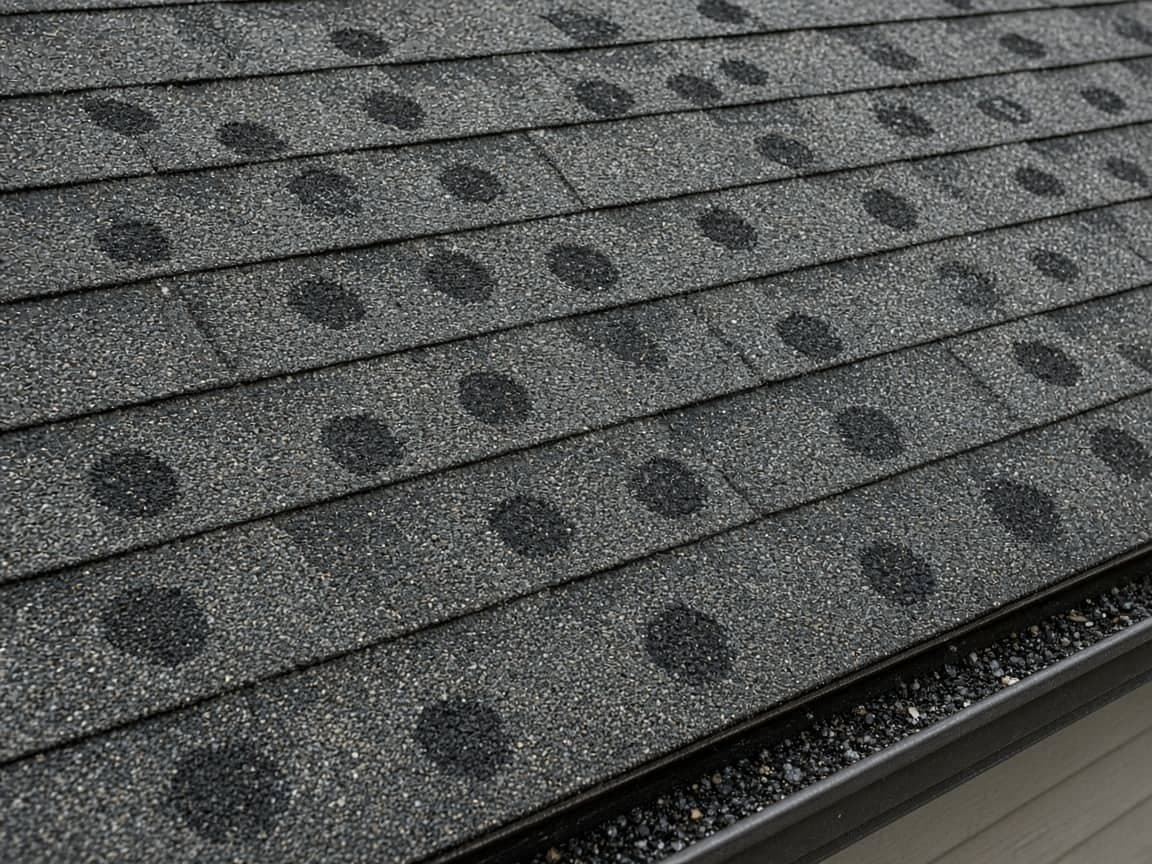
Hail and straight-line wind often arrive in the same thunderstorm over the Fox River. They do not leave the same mark, and a roof can carry both. Hail bruises the mat and knocks granules off in scattered spots, including on slopes you cannot see from the street. Wind lifts the leading edge, creases tabs, and tears courses off, usually starting on the west and southwest faces and along the ridge.
Read them apart before you decide the scope. A slope with a few missing tabs and no bruising can be a wind repair. A slope with random dark spots and dented gutters can be hail even though every tab is still attached. A slope with both — bruises in the field and courses torn off the edge — needs both stories in the estimate. Treating the whole roof as "storm" without saying which mechanism did what leads to a repair that misses the bruises, or a replacement that blames wind for ordinary sun wear.
- Hail: random dark spots, a sudden granule wash, dents in soft metal on vents, gutters, and flue caps
- Wind: creased or missing tabs in rows, ridge or hip caps gone, underlayment or deck open on the exposed side
- Both: bruises across the field and lifted edges on the windward slopes of the same house
- Neither, until you look: a dry ceiling, and a neighbor's roof two blocks away
If water is already coming through, catch it and use the roof leak repair guide for how a stain relates to the opening. The storm estimate still has to say whether hail, wind, or both put that opening there. Stay off the roof to collect the photos. Ground-level shots of the slopes, the metal, and any tabs in the yard are the record.
What if I do not see a leak after the storm?
A dry ceiling does not rule out damage. Hail can bruise shingles, and wind can break the seal between tabs, without an immediate drip. Water may show up on the next hard rain, or only as a stain weeks later. If gutters, vent caps, or window frames are dented, include that on the estimate request so the roof is checked with the storm in mind.
Soft metal records a storm when the shingles are harder to read from the ground. Look, without climbing, at:
- Dented gutters, downspouts, and gutter aprons
- Dented or loosened bathroom and kitchen vent caps
- Creased flue caps and dented chimney chase covers
- Splashed-off granule piles under downspout outlets
- Window screens, air-conditioner fins, and light metal trim with fresh dings — clues that hail reached the house, not a diagnosis of the roof by themselves
Flashing takes wind in a specific way. A counterflashing leg that was only cemented in can peel back. Step flashing at a sidewall can bend up. Pipe boots that were already cracked split the rest of the way. Those details leak in ordinary rain too, and a storm is often what finishes them. The roof repair guide for leaks, missing shingles, and flashing covers how those openings behave once the weather clears.
Interior water does not always appear during the storm. A bruise or a lifted tab may wait for the next hard rain. Water then runs along the deck and shows up as a stain feet away from the impact, or only in the attic as damp insulation. Check the attic from the hatch after the storm if you can do it safely. Darkened sheathing and a new drip at a vent are worth writing down before they dry and disappear.
Ice and late-winter leaks are a different mechanism from hail and wind. If the water shows up at the eaves after snow and a thaw, use the ice dam section on the repair page rather than treating it as hail.
Can wind damage be repaired without replacing the whole roof?
Often, yes, when the loss is a ridge, a few courses, or one exposed slope and the rest of the shingles are still flexible and sealed. Replacement is the clearer scope when wind creased shingles across most slopes, the deck is exposed in several places, or the roof was already near the end of its life. A Carpentersville repair estimate is the right start when the damage looks local.
A repair can cover the storm
- Tabs missing on one slope, with the field still flexible
- A ridge or hip cap torn off while the field is intact
- Lifted flashing or a split boot, with no widespread bruising
- A small area of exposed underlayment that can be covered and rebuilt
Replacement is the clearer scope
- Hail bruises scattered across most slopes
- Wind creases or missing courses on more than a local patch
- Deck damage, soft spots, or underlayment torn in several areas
- A roof already losing granules and curling before the storm arrived
Matching shingles matters on a repair. If the product is discontinued or the surrounding tabs shatter when they are lifted, a neat patch is not realistic and the estimate should say so. Color will not match perfectly even when the product is still made, because the existing roof has weathered.
Widespread functional damage is a full roof replacement in Carpentersville conversation. The storm did not have to invent every problem on an old roof. An honest scope separates what the storm did from what age had already done, then recommends one path.
Will a storm damage estimate file my insurance claim?
No. The estimate describes the roof condition that can be seen and the repair or replacement scope that follows from it. Opening a claim, what the carrier pays, and any supplement stay between you and your insurer. Nothing on this page promises an approval, a deductible outcome, or a public-adjuster service.
A storm damage estimate is a look at the roof and the related metal and flashing, followed by a written scope: repair specific details, or replace. It is free to request, and sending the form does not obligate you to hire anyone. Published national and Chicago-region cost ranges live on the roof cost guide. They are not a claim payment and not a price for this house. It is not an insurance filing service and it is not a public-adjuster service. Your carrier decides whether a claim is opened, what is covered, and what is paid. Nothing here promises an approval, a payment, a deductible outcome, or a supplement.
If you are deciding what to do after a storm, a careful order is:
- Document the damage from the ground once it is safe. Note the date, which side of the house faces the missing pieces or the dented metal, and whether any room or the attic got wet. Keep the photos. Do not climb a wet or debris-covered roof to get them.
- Request a free inspection and estimate. The visit describes the condition that can be seen and the repair or replacement scope that follows from it. Share what you photographed and what you did not see. Leave out damage you did not observe.
- Work with your adjuster if you choose to open a claim. You can show your photos and the written scope. The adjuster works for the carrier. Questions about coverage, timing, and payment stay between you and your insurer. An estimate does not negotiate the claim and does not speak for the policy.
Be accurate about what happened. A clear description of the slopes, the metal, and any interior water is more useful than a worst-case guess. If the ceiling is leaking, deal with the water inside while that paperwork moves, and say so on the leak repair request.
Storms over Carpentersville and ZIP 60110
Carpentersville roofing after a storm follows the same Fox River pattern every warm season. Thunderstorms build to the west and ride across Kane County. Some years the village only gets wind and a hard rain. Other years hail reaches the ground in one neighborhood and skips the next. Street-to-street differences are normal. A damaged roof two blocks away does not prove yours was hit, and a quiet street does not prove yours was spared. Look at your own slopes, gutters, and ceilings.
ZIP 60110 covers most of the village, from older houses nearer the river to later subdivisions set back from the banks. Both kinds of roofs take hail. Wind losses concentrate on the exposed elevations. If you live in East Dundee, West Dundee, Algonquin, Sleepy Hollow, the same storm cell often continues up or down the valley. Those towns are on the service area page for Fox River communities. If your ZIP is close and unlisted, ask when you send the form.
Winter storms are mostly snow load, ice at the eaves, and wind on cold, brittle shingles. Treat active ice-dam leaks as a repair request and mention the snow. Save this page for hail, wind, and the rain that follows them.
Has hail or damaging wind been recorded in Carpentersville?
Yes. The NOAA Storm Events Database logged 1.25 inch hail in Carpentersville on June 12, 2021, and 1.00 inch hail on June 29, 2020. It logged estimated 65-knot thunderstorm wind gusts near the village on August 10, 2020, during the derecho, and on June 13, 2022, plus estimated 52-knot gusts on March 30 and August 16, 2025. Those are weather records for a point and a time. They do not say which roofs were damaged.
The table uses the NOAA Storm Events Database only. Each row is one logged report: a time, a measured or estimated size, and a point. Wind speeds are in knots, as NOAA prints them. An estimated 65-knot gust is about 75 mph, and 52 knots is about 60 mph. Every row lists $0.00K in NOAA's property-damage field. Read that as the database entry, not as a statement about any roof.
| When | What NOAA logged | Where |
|---|---|---|
| June 24, 2026, 4:55 PM CST | Hail, 1.00 inch | 1.54 miles west of Algonquin, Kane County |
| August 16, 2025, 3:03 PM CST | Thunderstorm wind, estimated 52 knots | 0.95 miles northwest of Carpentersville. A tree fell onto power lines. |
| March 30, 2025, 12:46 PM CST | Thunderstorm wind, estimated 52 knots | 0.85 miles north of Carpentersville. Kane County EMA reported power lines down. |
| June 13, 2022, 4:59 PM CST | Thunderstorm wind, estimated 65 knots | 1.23 miles west-northwest of Carpentersville. Widespread tree and power line damage, worst east of the Fox River between Route 68 and Route 62. |
| June 12, 2021, 1:29 PM CST | Hail, 1.25 inches | Carpentersville |
| August 10, 2020, 2:30 PM CST | Thunderstorm wind, estimated 65 knots (derecho) | 1.46 miles west-southwest of Carpentersville. Whole trees uprooted, 14 reports of power lines down, and a tree on a house roof. |
| June 29, 2020, 2:31 PM CST | Hail, 1.00 inch | Carpentersville, reported by a trained spotter |
To check a date of your own, open the NOAA Storm Events Database, choose Illinois and Kane County, and search the days around the storm. If nothing is listed, that does not mean nothing happened. Reports depend on someone measuring or calling it in, and hail can fall hard on one street and miss the next. The date you first saw the damage, and your own photos, still matter more for your house than a county list.
What does Illinois law say about storm damage roofing contracts?
No. Under 815 ILCS 513/18, a contractor offering home repair may not advertise or promise to pay or rebate all or any part of an insurance deductible as an inducement to the sale, including through a discount or allowance offered for that purpose. Treat an offer to cover the deductible as a reason to walk away.
After a storm crosses the Fox River valley, door-to-door roofing sales usually follow. Illinois wrote rules for that. Under 815 ILCS 513/18, contracts, bids, and advertisements for roofing work have to show the contractor's Illinois roofing license name and number. The IDFPR roofer brochure says those numbers start with 104- and can be checked at idfpr.illinois.gov. It also says that after a catastrophe a contractor cannot represent you on your insurance claim or file the claim for you.
Under 815 ILCS 513/18, if a contract is to be paid from your property insurance, you can cancel it before midnight on the earlier of the fifth business day after your insurer tells you in writing that all or part of the claim is not covered, or the thirtieth business day after the insurer receives your proof of loss. Send the notice in writing to the address in the contract with a copy of the insurer's notice. This is a summary of the statute, not legal advice. The Illinois Attorney General's home repair pamphlet adds that you have three business days to cancel a contract signed in your home, and up to 15 business days if you are 65 or older and the contract came from an uninvited solicitor.
Before you sign anything after a storm, check for:
- An Illinois roofing license name and number on the bid and contract
- No offer to cover, waive, or rebate your deductible
- A written scope, with no blank spaces, and a copy you keep
- Payment by check or money order to the company, never cash, and no full payment until the work is done
- Who pulls the village permit, and when the final inspection happens
A free estimate request on this site is not a contract, does not ask for a deposit, and does not assign or file a claim. When you are ready, request a free storm damage roof estimate in Carpentersville.
Do I need a permit to replace a storm-damaged roof in Carpentersville?
Yes, for a replacement. The Village of Carpentersville Residential Permit Guide has a roof replacement checklist: the residential building permit application, a proposal with specifications, a copy of a valid roofing license or affidavit, and a homeowner's association approval letter if required. It lists a $50 permit fee, a $60 re-inspection fee, and a final inspection when the work is complete. Confirm the current guide with the village before work starts.
The village's one-day permits list puts roofing in the over-the-counter group. The Residential Permit Guide also lists minimum requirements for a roof replacement:
- Roofing installed to the manufacturer's instructions
- A maximum of two layers of roofing
- Felt underlayment parallel to the eaves, with at least a 2-inch overlap
- Ice and water shield, per the 2018 IRC
- A final inspection once all work is complete
A storm repair of a few tabs is a smaller scope. Ask the village whether it needs a permit before work starts. A house in East Dundee, West Dundee, Algonquin, or Sleepy Hollow follows that village's rules, which are on each Fox River town page. The roof replacement guide for Carpentersville covers tear-off, underlayment, and ventilation.
Storm damage estimates in nearby Fox River towns
A storm over Carpentersville does not land the same way in every neighboring village. Hail can continue down the east bank, crease west-facing slopes, or skip a subdivision entirely. Open a town for what to look at, then request a free estimate.
East Dundee, IL
ZIP 60118 · Kane County, with a small section in Cook County
Hail that hits Carpentersville often continues south along the east bank. Dented gutters and vent caps still matter when the ceiling stays dry.
West Dundee, IL
ZIP 60118 · Kane County
West and southwest slopes take the gusts. A storm that dents metal in East Dundee can crease a different set of slopes on this bank.
Algonquin, IL
ZIP 60102 · McHenry and Kane counties
A cell can bruise one subdivision and skip the next. Random dark spots and a fresh granule pile matter more than a neighbor's roof.
Sleepy Hollow, IL
ZIP 60118 · Kane County
Wind plus falling limbs. Dented gutters under trees can be hail or branches. Photograph what you see from the ground and say which it looks like.
Request a free storm damage estimate
Include the storm date if you know it, which side of the house faces the damage, whether shingles or metal are on the ground, and whether any room or the attic got wet. Choose storm damage on the form.
You will get a scope for the condition that is actually there: a repair, several repairs, or a replacement. There is no charge for the estimate and no obligation to continue.
Sources for this page
- NOAA Storm Events Database (search by Kane County, Illinois)
- NOAA event 957899: 1.25 inch hail, Carpentersville, June 12, 2021
- NOAA event 914390: derecho wind near Carpentersville, August 10, 2020
- NOAA event 1021631: wind near Carpentersville, June 13, 2022
- 815 ILCS 513/18, Repairs following damaging weather
- IDFPR, Find a Licensed Roofer (brochure)
- Illinois Attorney General, Home Repair: Know Your Consumer Rights
- Village of Carpentersville, Residential Permit Guide (roof replacement)
- Village of Carpentersville, one-day permits list (roofing: over the counter)